Sunday, November 04, 2007

The Moon Occults Regulus, 3rd November 2007

On the morning of the 3rd November, 2007, there was a challenging event that took place in the skies over the southern United States and part of the Americas; the Moon occulted the star Regulus in the constellation Leo. For many, this was not too much of an issue, since many points in the midwest and further were still in darkness. Here in Jacksonville, though, it would be occurring at sunrise.
Based upon the information I had on hand, this was going to be tough. I was pretty sure that it would be visible with binoculars and even just barely naked eye. But, I wanted to try and catch it on video. Based upon my experience with the VCR, though, I figured I'd see what sort of still images I could grab. For this, I used my Supercircuits CMOS camera fitted to my Meade 60mm (on an alt/az mount) telescope, "Spindrift".

I also opted to use my Samsung SCC-4201 for wide angle shots.


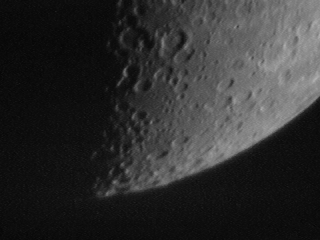
At 7:00am EDT, I had all of my equipment outside; the VMO-1 with my Power Macintosh 5260/100 "Sofia", "Spindrift" carrying the CMOS camera, and my Samsung, "Sammy". I grabbed my first few images between 7:10 and 7:12, switching between the two cameras.

Notice the bottom image on the left, taken with Sammy at 32 frames integration; you can actually see "Earthshine" lighting the Moon's shadowed section.


Even though it doesn't show, the sky was now medium blue. The contrast was making it appear darker in the cameras.

The first thirty minutes of any occultation are fairly uninteresting. I used this time to grab images and fine focus both instruments (for instance, the automatic focus feature on Sammy was turned off and had to be reset). At 7:31, it was time to begin recording the final series of images. Sammy obtained the following image as Spindrift was fine focused.


The sky was now brightening up significantly, but due to the CMOS camera's built in gamma correction (automatically adjusting for brightness and contrast), it still looks almost black. I started taking images with Spindrift and the CMOS camera alone. I collected almost 20, but these three pretty much summed it up, starting at 7:31, then 7:35 and finally 7:40...

Going, going, gone.
I could have waited the almost half hour to record the Moon's finishing its obscuring of Regulus, but instead decided to pack it in. It would probably have been too bright anyway.
Still, it was a wonderful way to test out my equipment and make the best of what I have. And for what I have, I am truly thankful.

Grabbing The Comet

I do video astronomy. For that purpose, I have a number of nice little cameras, ranging from old black and white security cameras to purpose built cameras. There are three cameras I use consistently, however; an old Sensortech B&W with telescopic lens, a basic little Supercircuits color CMOS camera in a purpose built housing and a very nice Samsung SCC-4201. That latter camera has come into its own for this comet.
The clouds finally began to break up after almost a week of overcast, on the evening of the 30th of October. I wasted no time and wheeled my VMO-1 (that's the Vagabond's Mobile Observatory 1) outside with Breanna's TV/VCR unit. At around 9pm, I finally had a hole. Through that hole, I finally caught the comet.

Unfortunately, I chose to use a VCR. This produced a lot of noise, and during the processing phase, I lost color. But I did catch it. The above image, by the way, is a paltry 5x!
It became overcast again, and would persist until the night of the 1st of November. Again, I wheeled the VMO-1 outside, but this time with my Power Macintosh 5260/100 on board. This ex-Torrington School District machine is setup for AV work. I call it "Sofia", and say what you will for its performance, for this task it was superbly fit. Now, I could forego the VCR and send the video directly to the computer. The results were much better.

The comet's golden color was now discernible. While this camera is not perfect, it is certainly a step in the right direction. With the addition of the Macintosh 5260, it has become an inexpensive means to obtain video imagery I might not ever have the opportunity. It also proves to me that what is considered by many to be a useless machine has found utility.

The Macintosh 5260/100 and my cameras, 1 November 2007

I suspect that there will be more adventures with this gear coming soon.

A Constellation, A Comet & A Missed Opportunity

So, there I am, Tuesday night, 23rd October 2007, preparing my souped up video camera to grab some images of Perseus. For the past couple of weeks, my column has run a series of articles regarding the Andromeda/Cassiopeia/Perseus myth. Since this week the series wraps up in Perseus, I wanted to grab some images of the more interesting objects within the constellation, namely the Perseus III OB association (one of my favorite objects).

The camera has had some work done lately. It now sports a better looking mount, made from corrugated plastic, some hardware and JB Weld, fixed snuggly beneath the main housing with very strong double sided tape. Not only has the greatly improved the sturdiness of the system, it also looks much better. I've also decided to employ my wheeled "Mobile Observatory 1", a combo toolbox/workbench with wheels. All was set for the night of the 23rd of October.

I was wheeling my equipment outside when the clouds began moving in. Perseus was still behind the trees; it was not quite 9:15. But I suspected that it would be high too late, that it would be obscured.

Indeed, I was to be proven correct.
As I was beginning to pull the extension cord outside, a sold line of overcast began to come up from the south, completely obscuring the sky for a large swath save for some sections above the east and west horizons. Adding insult to injury… it began to sprinkle.

Meanwhile, short period Comet 16P/Holmes was preparing to do something extraordinary amidst that very stellar association I intended to video.

It pains me so much to think I could have caught that flare real time. I understand how Charlie Brown must have felt whenever that football was yanked aside.

Ugh.

Tuesday, October 02, 2007

A Celebration; Four Centuries of Telescopes


It's raining outside as I write this. Northeast Florida is under a low pressure system that is producing a very nasty northeaster, with gales roaring in from off the Atlantic, rain coming sporadically. This is the second night of the "Great World Wide Star Count", a naked eye event that runs from the 1st to the 15th, and for the second night in a row, I'm stuck indoors as the stars have been hidden behind thick blankets of fast moving clouds. Today, though, is important not to naked eye astronomy but to a tool and the role it has come to play in this pursuit.
Today is the 2nd of October, 2007. Three hundred and ninety nine years ago, one Hans Lippershey announced that he had "invented" what would for a short time be known as a "Dutch perspective glass". He created this by placing two lenses, one larger with a long focal length, the other smaller and shorter in focal length, within a tube and thus magnifying objects some distance away.
The legend goes that two children in his workshop actually discovered this, though chances are good that others before him also created similar instruments. But no matter; he was the first to try and patent it (the Dutch authorities didn't allow the patent, though they did have him produce a number of such instruments for them).
Within a few months, Galileo Galilei, who had heard about these wonderful instruments, set about creating one for himself, improving the design and naming his version a "telescope". He would be the first to aim one towards the heavens in late 1609, and forever changed science and our understanding of the world around us.
Next year is the beginning of the 400th anniversary of this wonderful tool. The International Astronomical Union has designated 2009 the International Year of Astronomy. But in my mind, the time period needs to start on the 2nd of October, 2008 and run through the 15th of January 2010, when Galileo realized that four attendant stars near Jupiter were actually moons.
Fifteen months seems like a fair way to celebrate 400 years of the telescope.

Wednesday, September 19, 2007

Our Moon & Four More

Time to resume Vagabonding, and to start things off, I've decided to do something of a little comparison. On Friday night, the 21st of September, the Moon will be slightly past first quarter and sitting high enough in the sky to make viewing good. Normally, for most astronomers, the Moon is a nuisance; the amount of light it reflects (notice; I said reflects and not emits) is considerable, and only the brightest objects can be seen with relative ease. The Moon, though, is quite worthy of observation, and I, for one, always try to observe it whenever possible, regardless of its phase.

Most of the detail we will see in this session will be along the terminator, where the shadows are still long (I've written about this in my "First Coast Sky @ Night" column). Those shadows add the necessary contrast for bringing out detail normally hidden from view. As you move away from the terminator and towards the limb (the edge of the sphere itself), you'll notice that the shadows diminish in length and detail is slowly erased due to an ever increasing angle of sunlight. Still, there is much that can be seen.

But Luna, our Moon, is only one of five we should be able to see that night. To find the others, we need to locate the planet Jupiter.

Jupiter is currently residing in the constellation Scorpius in the southern sky and is prominent just after sunset. You'll have no trouble at all locating the planet, as it will be by far the brightest object in the southern sky. It is far brighter than the red star Antares, which lies nearby. Once you've located Jupiter, a look through even a small telescope will reveal four small star-like objects sitting very close to the disk, the Galilean Satellites. The instruments I'll be using on Friday night will only allow us to view these four, though it should be remembered that Jupiter has an enormous retinue of moons, over seventy at last count. These four, its largest satellites, are planets in their own right, with Ganymede even larger than the planet Mercury.

The Vagabond Astronomer will be set up in the west parking lot at Ed Austin Regional Park in East Arlington after 8:00pm. To locate the site, I've included a map to help out. Hope to see you there!


ADDENDUM - 21 Sept.

A tropical depression formed in the Gulf of Mexico from a series of storms that crossed the state of Florida today. The weather deteriorated and ended up clouding up the night, so the little event was called off. Sigh. Oh well, there is next week...

Wednesday, July 18, 2007

Wednesday, July 04, 2007

Largest Planetarium Dome - Infinite In All Directions

I read today in "Sky & Telescope" about the Shoemaker Open-Sky Planetarium in Chico, California. What's so special about this facility? Its outdoors; there is no dome. For all intents and purposes, it is a traditional planetarium minus a projector and a dome on which to project.
Who'd have thought?
For the past few years, I've been toying with the idea of either making a portable planetarium or building a small dome in some equally small community. Well, this little idea pretty much blew me away. It seems that all this time I was missing the point; who needs a portable planetarium when you have the whole sky, and let's face it, it follows you wherever you go. Think about it; all you really need is a laser pointer. The visitors can bring their own lawn chairs or other contrivances (inflatable mattresses to basically look straight up would be nice).
What is needed to make this idea really work is other media.
At the Shoemaker, they have computer guided telescopes with cameras attached. Each of the visitors is given a small handheld viewer to see the objects selected.
Nice. Complicated but nice.
What makes a proper planetarium work is the other media present. The sky by itself is great, but if you're talking about, say, M57, the Ring Nebula in Lyra, you need to go a step further, otherwise you're pointing towards what appears to be a blank spot between two stars. Either a canned image or a live CCD image would be just spectacular. The trick is how to present it. Perhaps an LCD projector and screen located in the center of the gathering, one that can be completely blackened with a simple shutter mechanism.
This has potential. Must dwell on this some more.

Monday, June 04, 2007

So Little Time...

I've been very busy. Life has a way of doing that to you; it sneaks up on and swallows all of your spare time to the point where things that matter so much to you suddenly get placed further and further on the back-burner, to the point where they verge on being forgotten altogether.
While that's not the case with my love for astronomy (I've started a column and have been writing it for the past two months), it has become the case with my Vagabonding.
I just don't do it as much as I once did. And that's sad for me.
What I loved so much about my form of astronomy is that I didn't have schedules to keep, agendas to order. I just picked a night, a location, and I did it. Very simple. It was sidewalk astronomy with an edge. It worked for me.
It's not that I haven't done events, I've done several in the past month alone. But these were always meticulously planned and plotted The spontaneity ceased to matter. Now, don't get me wrong, the NEFAS sponsored events have to be organized. Not that I have anything against organization; for those events to run properly, there has to be organization. At least a basic plan of some sort.
The whole idea behind the Vagabond Astronomer was to bring the stars to the people; "One man, on a mission...". They were random events. Set up the scopes where the people are, that was the idea. Book store parking lots, city parks, sidewalks. If there was room for telescope or two, I'd try to be there.
Even beyond that, though, is the issue of time. Somehow, I've managed to mismanage my time to the point where I can't set aside even a few hours a week, even just a couple, for this noble (and yes, it is) endeavor. I don't watch much television (darned little at all, in fact). Surely, I can fit this in.
I also miss writing on this blog. Somehow, the column has supplanted the blog, but it's not nearly as personal. It isn't necessary for the two to dovetail into one another, they should remain separate. How long does it take me to write? Not much time at all, in fact, once the creative juices are flowing. And when it comes to astronomy, my mind is, well, always on it. I won't lie about that; I am obsessed with it! And I want to share that. And I've not been doing it as well as I used to.
How long will it be before the Vagabond is up and running again? Sooner than you think.
I hope.

Friday, April 27, 2007

Telescopes & People

I've made many discoveries in the past twelve years as a space advocate and astronomy educator. When dealing with a visually attuned public, you need visuals, be they videos, slide shows or models. The discoveries I made deal with the fragile nature of these items.
The first thing I discovered is that regular commercial model kits are far too fragile, the more detailed the more fragile. Many has been the time that a model of the space shuttle has returned to me with parts askew. So, I've resorted to making sturdier models.
The same is true of telescopes. Especially when one considers the costs of even a small telescope versus the costs of even a complex model (which is usually in the form of hours spent building it).
The problem is that even simple telescopes and their mounts can be sensitive affairs. True, it is pretty difficult to break a metal mounting bracket, but that isn't the real issue here. The real issue is that, aside from one telescope design, most telescopes are really not designed to be used in large group settings.
The most common telescope mount is the altitude/azimuth (or alt/az) mount. This is the one you'll find on most cheap telescopes and it provides the two most basic planes of movement; lateral and vertical (that is, side to side and up and down). For low power, this is an ideal setup. Their problem lies in the fact that the Earth is rotating; soon the object you have them aimed at drifts out of view. Simple fix; you simply move the telescope, right? Well, you end up moving it slightly in two different planes, but again for low power, this is fine.
Astronomers overcome this by resorting to another mount design, the equatorial mount. This allows the telescope to track objects by being aligned with the Earth's axis; its movements match right ascension (RA) and declination (DEC). Two stay on an object is simply a modest move towards the west. Many of these mounts are motorized and will stay on their targets when properly aligned.
It's that proper alignment that is the issue here. People are people and will want to move the telescope themselves, and in doing so might move it off axis, creating a problem in trying to keep an object on target.
What do you do in either case?
For a long time, I'd only take one telescope on my outings. That's great for basic Vagabonding. When I'm in a class setting, though, it gets trying, so several scopes have to be brought. To keep people from bumping into one another while using the instruments it is necessary to keep them fairly distant from one another. Example; one telescope might be aimed at the Moon, another aimed at Venus and yet another aimed at the Beehive Cluster. The distance between them should be better than ten feet. Sounds easy, but what usually happens is I find myself running from one instrument to another. Good exercise, at least!
Then, a visitor, in their desire to be helpful, turns the wrong thing, sometimes the focuser. I'm serious here, some people think that that will move the telescope, or that the previous person unfocused the telescope and that the target hasn't drifted out of the field but is simply extremely out of focus. In their frustration, they then start to move the scope itself around, pointing everywhere in an effort to find the object. Try as they may, it simply adds to their frustration, followed by the plaintive calls of "Mr. Little? We lost the target!"
Sigh.
But this is not really a grumble, for there are solutions. First, let them know that telescopes are sensitive by their nature and that if something does go wrong, simply call for the professional on site (me). Second, because there will be those who want to help, give a basic explanation of the parts of the scope; which ones they can touch, which ones they shouldn't ("you can move the scope if you want to, but please don't touch the focuser"). Third, and this is tied to the second point, make sure that finder scopes are properly aligned and explain its purpose before your viewing begins. Trust me here; I failed to do that on my last outing as I was running late. There were many very bright people in that group who could have done the job, but since I hadn't done mine, they couldn't help. Lesson learned; take time to make sure they are aligned. By following those rules, a group viewing can be guaranteed to be a success. Believe me, the teacher has been taught!
Now, what sort of telescope is best suited for large public viewings? The Dobsonian. Easy to use, easy to setup, compact mount (try transporting eight tripods in a minivan and you'll long for Dobsonians!), the Dobsonian is perhaps the best tool for the trick.
And I lack one.
Sigh...

Friday, March 09, 2007

A Tale Of Two Worlds

"Just how many planets are in the sky right now?"

That's a question I've heard time and time again. That is actually a complicated question that has a few answers. The truth is that they are all in the sky... the question really comes down to which ones can you see?
Fortunately for us, there are two fine examples visible right now after sunset, Venus in the west and Saturn in the east. Both are glorious in their own right, with brilliant Venus heading towards elongation (its highest point in the western sky, which it will reach on June 9th) and golden Saturn sitting in Leo, not too far from the bright star Regulus (but far out shining it).

The First Star I see Tonight... Isn't...

(image courtesy of "Your Sky")

A star, that is. Even before the last traces of sunlight fade in the west, Venus blazes, very much like that ephemeral "diamond in the sky". Wait until approximately 7pm ET (8pm EDT) to get a good idea of why this planet is frequently mistaken for airplane landing lights (or a UFO!); it is extremely bright, rivaling only the Moon in the night sky. Right now, as viewed telescopically from Terra Firma, it looks for all the world like a gibbous moon. In fact, when viewed from Earth, Venus goes through phases. This is what Galileo discovered in 1610 (both Mercury and Venus appear to go through phases; however Venus is by far the easiest to observe. You need a pretty good telescope to observe Mercury's phases). When Galileo made his observations of Venus, he confirmed the Copernican model of the Solar System to be correct, that the planets orbit the Sun.

(image courtesy IMSS - Firenze)

Even with a modest telescope, you can observe these phases. However, they will not be truly startling until after maximum elongation (again, June 9th), when it will cease to be even and ellipsoid and start to go through quarter and crescent phases. Not only will the phases be more dramatic, Venus will appear larger, since this portion of its orbit rakes it closer to our Earth. For now, Venus should appear as a small, albeit lopsided, disk. It is best viewed with at least 50 magnification in order to show even this (more on that, but next...).

The Lord Of The Rings

Well, I'm pretty sure that that particular label has been applied to Saturn perhaps too often, but was once applied to yours truly in an article in the Palm Beach Post way back in December 2001.

(image courtesy Palm Beach Post)

But this is about the planet Saturn and not me. So much has already been written about Saturn already but I feel that there is always room for more. Saturn is simply amazing these spring evenings. It passed opposition (when it lies opposite the Sun in our skies, effectively coming up at sunset) on February 10th, at which point it was at this orbit's closest approach. So, it is still relatively nearer to us at this time than it normally is.

(image courtesy of "Your Sky")

It is important to remember, though, that the planet Saturn is already 9 times larger than Venus (and its near size twin Earth) and lies over ten times more distant. Its rings span out over twice the planets diameter as well. What does this mean to us here on Earth?
Basically, it means that even a modest telescope with as low as 20 magnification shows Saturn as more than just a disk; it looks like a grain of rice at low power, and 50x and above show the true majesty of the ring system.
This is a great time for observing both planets, but as summer rolls along and Venus begins its descent back into the sunset, the skies will become even more wonderful as Saturn joins it in the west for a celestial rendezvous. Stay tuned!

The Vagabond will be setting up at Ed Austin Regional Park off of McCormick Road at 7pm on March 13th, near the western most parking lots. While light pollution will no doubt be a problem, we will be looking at two fairly bright objects. A little further afield and later in the week NEFAS and my fellow members will be out at Osceola National Park on the night of the 17th as well.

Hope to see you soon.

Tuesday, December 19, 2006

Why Do This?

I just returned form another successful thrift store run looking for used optics. Score this time was a pair of Sears 7 x 35 porro prism binoculars, as well as a much needed (and brand spanking new!) external USB floppy drive for my my iBook plus a Pickett N1010-ES slide rule (it's a geek thing, you wouldn't understand). Total for the entire haul - around $10 USD, the binoculars costing just $2.99 (the slide rule was $2 and the floppy drive $5... and did I mention it was new?). The quest for cheap optics might seem a little obsessive, but there is a good reason for it; optics are not cheap, and my vocation of sharing the stars with the masses requires that I have plenty of tools for the task at hand. Binoculars are wonderful for this, even if 7 x 35s are on the smallish size.
How much do I make off of Vagabonding? Nothing.
So, I spend with no hope for compensation. I have at last count eight usable telescopes plus the parts to make two more, and all of them are being setup for Vagabonding. Again, more out of pocket. And I'm not complaining... this is my mission, after all, my vocation and my gift to the world.
It might seem a Quixotic pursuit at times, and one that might even be fraught with serious problems. But this is my take on it; you get enough people to look up at the night sky, at the wonder that is Creation, and perhaps you can inspire them to think of grander things and see that humanity has infinite possibility. The night skies and the true depth of the universe can seem incredibly humbling, making us seem tiny in comparison (and, to be honest, we are). The universe, though, might be ours for the taking if we believe that we can reach those worlds, around our Sun and the countless others that circle stars nearby and distant.
I especially enjoy working with young people, children. Some of them are genuinely enthralled with the grandeur and the beauty of the cosmos. They have not been humbled down by life and for them the possibilities are truly endless. In his 1977 book "Illusions", writer Richard Bach has a character describe the human race as the "otters of the universe", that in reality we are all fun loving, adventurous beings. This is especially true of the young. For them, there is time and space enough for play and adventure, and for many the universe offers just that. Encouraging children to view the universe not as just some distant, inaccessible place but as a place where we live gives hope to humanity, that we can continue to thrive through adversity; ad astra per aspera.
I've often quoted this but it certainly bears repeating. Back in December of 2002, I attended the Connecticut Forum "Scientific Journey" in Hartford. One of the panelists was Edward O. Wilson, the noted naturalist. Towards the end of the forum, there was a question and answer session and the following was put to Dr. Wilson; "how long do you think the human race will last?"
With nary a pause, he responded "I think we'll last forever, or at least until the end of time."
That is a sentiment I share as well.
So, why do I do this? Because we have within us the ability to last as long as the universe itself, and maybe even beyond that. We have been endowed with that possibility. We should encourage it in each and everyone of us. Perhaps, if we look up long enough and dream of those distant pinpoints of light, we may begin longing to reach them.

Sunday, December 03, 2006

Clusters, Associations & Solar System Models

I admit that the title of this post is probably a bit confusing. Okay, perhaps more than just a bit. But, the Vagabond will explain. As usual.

Stellar Families In The Winter Sky - Open Clusters & Associations


This is a great time of the year to look at some of my favorite objects, clusters and associations. Clusters are just that, groups of stars all moving in the same general direction and gravitationally bound in some form. They generally fall into two categories, globular and open. There are big differences between these two types. Globular clusters contain many thousands of members in a roughly spherical shape (hence, globular) and are made up of ancient red stars. They are fairly distant from our Solar System and orbit the core of our galaxy, forming a halo of sorts.

(image by Robert Little)

Open clusters, on the other hand, tend to be made up of much younger stars and contain only a few hundred stars usually (some may contain more than a thousand). Unlike globular clusters, open clusters orbit within the plane of the galaxy and some lie fairly close by (within a few hundred light years).

(image by Robert Little)

Associations, also known as stellar associations or moving groups, are clusters that have dissipated over time. You see, eventually gravitational interaction and a cluster's movement through large molecular clouds cause them to eventually disperse, causing their gravitational interaction to dwindle and eventually to cease affecting them altogether. The remnants of the cluster are stars that move in the same relative direction, though many times the resemblance to an open cluster persists when they are viewed at a distance.

(image courtesy of "Heavens Above")

The winter sky, which in early December rises not long after sunset, has three very notable open clusters (well, really, four) and a wonderful stellar association. The most obvious of these are the Pleiades, the famous Seven Sisters of yore, also known as M45 and NGC 1432. The best thing about all of these objects is the ease with which they can be found, though one (or is that two) of them is (are?) a bit more challenging. You need nothing more then patience to look for them on winter nights; that and a thermos of your favorite warm beverage.

(image courtesy of "Your Sky")

Looking very much like an even smaller Dipper (and in fact sometimes confused with the Little Dipper), the Pleiades are the most notable open cluster, even though the brightest star within the cluster is only a modest magnitude 3. There is some confusion as to why this cluster is known as the Seven Sisters, though many astronomers believe it is possible that one of the stars, Pleione, may have been brighter once; however, many people with very acute eyesight are able to see more than seven in near perfect conditions (my best friend says she sees fourteen!). When not viewed directly, though, the Pleiades have a strange glow about them, almost mist like. This is in no certain terms due to the large number of faint stars all concentrated into an area roughly four Moon diameters in size (around 2°). The truth is that there are many more than six or seven or fourteen stars in the Pleiades; there are, in fact, several hundred. With binoculars, it is easy to see as many as fifty, but you do not want to use too high a magnification to view this set of jewels. It is best viewed through binoculars or very low power (rich field) telescopes.
The brightest members of the Pleiades, and in fact most open clusters, are blue giants, massive, brilliantly burning stars that are very short lived. Because of their mass, they burn up most of their fuel in very little time, typically no more than a few tens of millions of years, and they go out as supernovae. Many of the stars within the Pleiades are not visible in binoculars, so the sheer number that actually make up this beautiful group remain hidden, only manifesting their presence telescopically or with larger aperture instruments.
As this small cluster moves along through space at a distance of over four hundred light years, it is passing through a cloud of dust. While not readily visible through binoculars (though possibly faintly visible to the naked eye using averted vision), this cloud adds to the beauty of the Pleiades when photographed, like splendid cirrus clouds floating amongst these fine stars.

(image courtesy Royal Observatory Edinburgh / David Malin)

Sitting nearby but not as conspicuous is another open cluster, the Hyades, disguised as the head of Taurus the Bull. When you look towards them, the first star that jumps out is the Aldebaran, the angry red eye of Taurus. This brilliant star is actually less than half the distance of the cluster, less than seventy light years out and is not associated with the cluster.
They Hyades themselves are actually very similar to the Pleiades though much older, on the order of half a billion years, and are more spread out as they have aged and drifted. Because of this fact, they are not as conspicuous a cluster, though a view through binoculars gives it away and shows its true nature. As with the Pleiades, there are many more faint members, giving a total of perhaps a couple hundred stars in total.
As impressive as the Pleiades but many times more distant lie two massive clusters, the famed Double Cluster in Perseus.

(image courtesy of "Your Sky")

Lying several thousand light years away, the Double Cluster, like the Pleiades and the Hyades, is made up of blue supergiant stars; however, due to its distance, even on the most clear nights it appears as strictly two small fuzzy patches in the night sky, lying halfway between Cassiopeia and Perseus. While easy to find in binoculars, this twin cluster is best viewed telescopically, though even a modest telescope (as small as 50 mm) will bring it to life. Many astronomers feel that the two groups that make up the Double Cluster are actually gravitationally linked, that they actually influence each other and perhaps even share a common origin.
Also lying within the constellation of Perseus is a sight that surprised me the first time I saw it, a dazzling array of blue white stars sitting near Mirfak (Alpha Persei), the brightest star within Perseus. This is not a cluster but a stellar association, the Perseus III group.

(image courtesy of "Your Sky")

Again, we're back to an object that is best viewed through binoculars. An association can best be thought of as a cluster that has matured, and like a family whose members have grown up, has begun to move apart, no longer influencing each other and their courses. The night sky actually has many associations; our Sun sits on the outskirts of a massive one, in fact. The only clue that gives away the presence of many associations is shared relative motion by member stars. Because of this, many associations are simply lost to the night. Luckily for us, the Perseus III group is distant enough to all share the same region of space when viewed from our Solar System. As viewed at 7x, the number of stars (around thirty can easily be made out under the right conditions) is startling, especially considering the proximity to other, apparently brighter (though actually much closer) stars.

The Solar System... In Ed Austin Regional Park

At my Freewebs site I've uploaded a page that shows a model of the Solar System built alongside Huffman Boulevard in Jacksonville's Southside. Looking to teach young people in various parts of our vast city, I've found myself looking at other parks and places to set up the same model, and Ed Austin Regional Park actually lends itself rather nicely. These Google Maps images (taken while improvements were still being made to the park) show how easy it is and how the contour of the park lends itself to the task. The Police Athletic League clubhouse actually sits on a rise in this former country club, and if you place our little 142 mm Sun near it, you can fit the entire inner system in the parking lot, while the two largest planets, Jupiter and Saturn, are near the periphery.

(image edited from "Google Maps" )

How about the rest of the Solar System? Yes, amazingly, you can even get Pluto (STILL a planet in my book!) to lie within the park!

(image edited from "Google Maps" )

Why is this an ideal setup, though? Basically, the Sun sits higher than many of the other locations I've chosen before. The advantage, simply put, is that the Sun remains readily visible down the entire model; if our little model Sun glowed, it would appear very much as it would from the actual planets themselves, appearing the same size when measured in angular size (though Pluto actually sits beyond a rise going into the park if you set it alongside the main road). While not a straight line (and again the images are a little misleading; the base images were taken during renovations and therefore not accurate), it does provide us with a useful model, one that has marked advantages over the original model laid out in Mandarin Park.
The Vagabond Astronomer will be at the Ed Austin Regional Park starting at 4:00 PM on the 8th of December, 2006, helping students build his model Solar System. Starting at 6:00 PM (after a picnic dinner), we'll move to the west end of the soccer field parking lot with a few telescopes to view those aforementioned clusters and anything else that might attract our attention. Hope to see you there!

Wednesday, November 08, 2006

Transits & Transitions

There are times when the Vagabond Astronomer is perhaps a bit too random. The 8th of November, 2006 is a good example.
What set this day apart from other days is the fact that on 8 November 2006, the planet Mercury made a transit across the Sun's disk. I had plenty of advance warning; astronomy is a science of numbers and very advance planning, and this transit has been known about for many, many years. At least I did help a few friends brainstorm and plan sessions. I decided to do mine pretty much last minute. However, typically me, I decided to use this wonderful event as an educational opportunity for a group of students from Christ the King School here in Jacksonville. It's not every day that you have an opportunity to not only talk about the vast distances between planets but their motions as well, and this transit was perfect for that.

You see, there's a lot more to teaching children astronomy than just science. Astronomy is a subject that teaches about our place, not only here on Earth, but where we are in the universe. It is so easy to get overwhelmed by the numbers, and in astronomy there are some huge numbers. The numbers are just numbers, and there are ways to talk about the vast distances that are far easier than throwing out "millions and millions". For me, it's the use of models that helps. If you can show a child that if the Sun were 142 mm in diameter then the Earth is about 1.3 mm, a mustard seed, they have a pretty good idea that our Sun, a star, completely dwarfs its planets. You give the model to a child, and they become that object. In this illustration, Breanna serves as the Sun......while Madeline is Mercury, Rachel is Venus and wee little Marian is Earth.
The scale that was used is the same as that used for my "The Solar System In Scale" model, but since we were only talking about the inner three planets, we didn't need to cover a lot of ground (though the parking lot we were in would have easily allowed a good chunk of the Solar System... and there are plenty of temptations there for the future!). Once they could see what the distances were like, I went on to explain that the planets do not orbit in the same plane, that indeed each has its own orbital tilt or inclination. With that explained, and by demonstrating how little of the sky the Sun actually takes up, they could see how few degrees makes a big difference when it comes to the alignment necessary for transits to be visible at all.
After the demonstration came the actual viewing session. I chose "Benjamin", my Apogee Widestar 80mm refractor (one that Rachel instantly fell in love with and hovered near for the remainder of their visit).


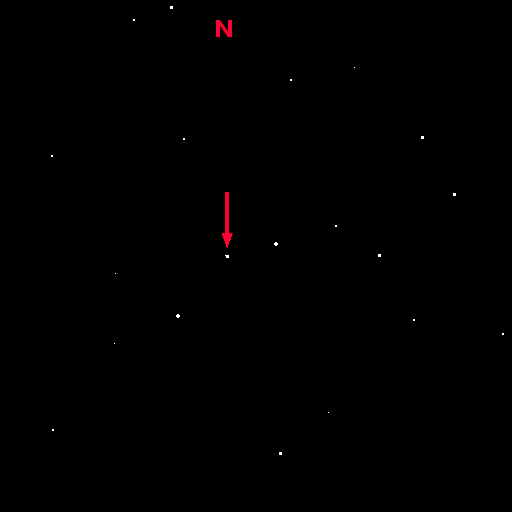
Again, they were amazed... little Mercury was just a speck against the disk of the Sun, though a clearly circular one. I tried to take an afocal ("through the eyepiece") image of the transit, but this was the best I could do (Incidentally, this method worked well with my images of the Moon, but not for this transit).

Mercury is indicated by the arrow. As you can see, it is just a mere speck.
The astronomy and science aside, there is something important here and I am just glossing over it. The window of opportunity to teach anything to young people is very narrow. To help them grow and develop a true appreciation for the world and the universe around them, you have to encourage them when they are young. Youth is a transitional period in life, and like a planet passing over the disk of the Sun, it can be both a rare and wonderful thing. If we can encourage and inspire them during this phase of life, they grow and learn and perhaps one day will set out to inspire others as well, if only through their example. Get them to look around now, and they will forever find wonder in Creation.

...A Time To Return

That is to say... I'm back home in Jacksonville. Pretty much all I needed to say here!

Tuesday, August 15, 2006

A Time To Go

There comes a point where you find yourself looking around and realizing that perhaps a change is needed. That's exactly the situation I find myself in at this moment. Because so much has happened this summer in my regular day-to-day existence, I now find it necessary to change locales. To that end, I am returning to West Palm Beach fairly soon. The downside is an increase in light pollution. The upside, though, is an area that is far more open to the brand of astronomy that I practice.
I don't plan on staying in West Palm Beach permanently. But for now, it's needed. There will be one last Vagabond Astronomer event here in Jacksonville, and I will post the when and where at that time. My way of saying goodbye to my hometown, as only I can.

Wednesday, August 02, 2006

50mm Memories

They say that you never forget your first. I certainly won't. Since 1973, I had owned a pair of K-Mart 7x35 binoculars, my first astronomical instrument. They served me well (and in fact still do, three decades later). But I wanted a real telescope. As an adolescent, there was no way I could afford what I really wanted; a 6"/150mm Newtonian on an equatorial mount. At least I could dream.
When I graduated high school in 1981, my friend Scott Spooner and I ended up over my friend Scott Moots' house one night after a party. He had to go back to his bedroom for something, and we just tagged along, carrying on a conversation (probably about my fixation on the Electric Light Orchestra). In his room, I noticed a telescope tucked into the closet. Just a small one. I asked Moots about it, and he responded, "oh, yeah, it's yours!"
And with that, I became the owner of a Tasco 50mm telescope.
It wasn't great. The biggest problem was really the tripod... what there was of it. It was a table-top tripod, not good for anything really. I had a spare camera tripod, so I modified the little telescope to fit on that. It had two eyepieces, a 20mm and what I think was a 5mm... that got tossed in no time, as it was unbearable. The diagonal was the old standard .965", so there were still some additional eyepieces I could get. Instead, I chose to stick mainly to the 20mm.
My first night with it was memorable. I chose to watch Saturn. With a 20mm eyepiece in a telescope that had a focal length of 600mm, I knew that I'd be looking at only 30x. Still, I was startled. Even at that low power, it was clear that Saturn had rings. I was hooked big time.
I followed that scope with a 70mm, which served me well. But the 50mm was used quite a bit for the next decade. In fact, it outlived the 70mm, as I sold it when I found myself penniless in 1987. Sometime in 1991, the 50mm finally gave up the ghost and was disposed of; it had been dropped and the objective broke.
Still, it was that small scope that gave me my first steady views of the heavens. I'm an advocate of small telescopes. My smallest telescope, "Lil' Bernie", is 57mm, though I do have a classic three draw 35mm, "Hans", that I use for some experimentation (it is optically a nice little scope). Small telescopes have advantages, namely in portability and costs. I've heard it said often that once you graduate from binoculars and want a larger instrument, you should really save up and buy something with a minimum of a 4"/100mm aperture. That's good advice, but for some, that outlay might still be used elsewhere in their lives (for, say, food, clothing and shelter). Small telescopes, 3"/76mm and down, might be a better alternative for them. It's just important that they are steered towards good manufacturers.
The 50mm has gotten scarce these days, being replaced by the 60mm. Tonight, though, I spent half an hour looking on eBay for 50mm telescopes (there are a number of new manufacturers putting them out, but I tend to gravitate towards names I recognize). Nowhere did I see the familiar white tube that marked the Tasco telescopes of that period. I hope one day to replace that scope. I might have instruments many times larger and far more capable. But you never really forget your first. Besides, I can probably find a way to justify it.

ADDENDUM -
Just discovered a review of the same telescope at "Cloudy Nights", "Tasco Model 6TE-5 50 mm Refractor". Yes, that was my telescope!

Tuesday, August 01, 2006

More Experiments In Cheap Digital Photography

I just couldn't leave well enough alone.
I decided that I had to try photographing the Moon one more time with the little Mercury point-n'-shoot digital camera. However, this time I chose to use one of my home made neutral density filters. This time... success... sort of.
Most of my image editing is done on my PC, an HP Pavillion running Windows ME. The problem is that computer is currently down; it runs for about ten minutes and then goes unstable, possibly due to some bad RAM (near as I can tell). So, I have to use what image editing software I have on my Macintosh G3 Blue & White, "Alcyone" (yes, I name my computers, too). While Macintoshes are superb graphics machines, I lack the funds to buy the proper software at this time, so I am forced to use some free alternatives, namely Futurepaint 2.1 (running in Classic mode under 9.2), NIH Image 1.63 (which is actually very nice for black and white image processing, also under Classic mode) and Preview in OS X.
Still, the results weren't bad. The first image was taken with "Bianca" (my 60mm) through a 20mm Kellner.


Using Futurepaint, I resized the image and did a little sharpening. After I did that, I used Preview to change the image's attributes, though I should mention that the image is still a mirror image Moon, much as you would see through an eyepiece. I'll correct that later. The results weren't too shabby.
The next image was taken with the addition of a 2x Barlow.


This time, I chose to use NIH Image for the processing alone. The results weren't bad at all. However, you can't really save images in NIH as JPEG's, so again Preview was used to convert the image. I should mention that I have used NIH Image before for grayscale image processing, and the results were always great (In the next month or so, I should have another computer set up specifically for image processing running Ubuntu and Gimp).
There are a lot of ways to record your astronomical adventures inexpensively. Certainly, the day is coming when I will be asked to write a webpage on my methods. Until then, I will always share the fruits of my labors.

Monday, July 31, 2006

The Moon & The Virgin

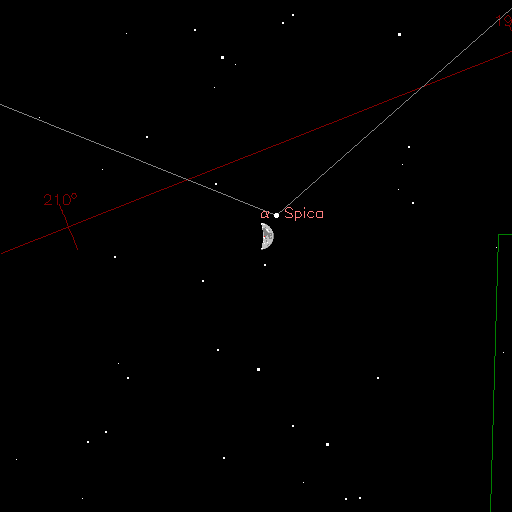
31 July 2006 - Tonight was not really a planned session for personal observing. I was at a meeting when I became distracted by the fact that, for the first time in days, the sky was clear. How could I concentrate on the meeting while the heavens were waiting? So, I left the meeting, obstensibly to try some experiments with a small digital camera (a Mercury CyberPix S-550V, pretty much just an aim-&-shoot) through my old 60mm 450mm fl short tube refractor "Bianca". But there was something else I had been wanting to see; our Moon sitting just south of the bright star Spica in the constellation Virgo. Professor Jim Kaler's website has some great information on the star, as well as many others.
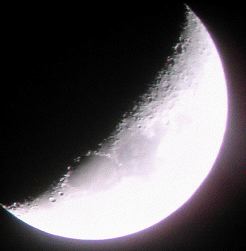
First, let's talk about my little camera experiment. Was it a success? Well... yes and no. Yes, it was successful in that it showed that the little work around I found for digital cameras worked (using a small tripod to hold the camera to the eyepiece). The images, however, were overexposed. The sensor that sets exposure does not aim into the telescope, and was pointing towards darkness. The camera's response was to increase exposure time. So, you get this...


That was the best image of the night.
Still, all was not wasted. I spent a number of minutes just looking at the Moon sitting just under Spica. It was an amazing contrast. Spica is the 16th brightest star in the night sky, and was easily holding its own against our obviously much brighter Moon (not that the Moon would actually be brighter than a star; Spica is around 260 light years away, while the Moon is 238,000 miles/383,000 km). The other stars really stood out tonight as well, the rain cleansed air being particularly clear. I spied Jupiter and the Galilean satellites. A few minutes later, I swung Bianca around and viewed Albireo.
But it was the wonderful sight of the Moon sitting in such proximity of Spica that really made the night, as our nearest celestial neighbor visited a maiden, high in the southern skies.

(image courtesy of "Your Sky")

Thursday, July 13, 2006

Seeing Double?

(IMPORTANT UPDATE - Read this comment)

One of the most marvelous things about the night sky is the subtle variety in the stars, and the secrets some of these stars hide. Our eyes allow us to discern color, but our eyes were not created as precision astronomical instruments. Thank goodness for optics, for what we perceive frequently as single stars may in fact be two or more. We refer to these as multiple star systems.


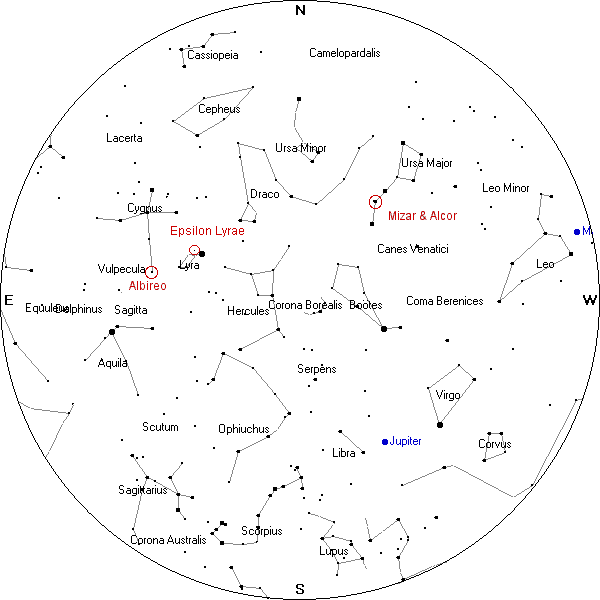
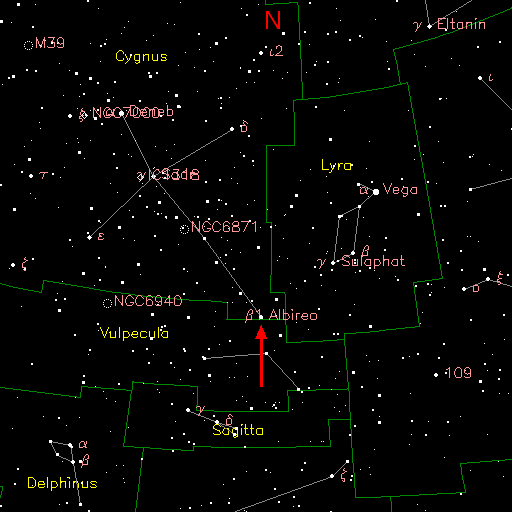
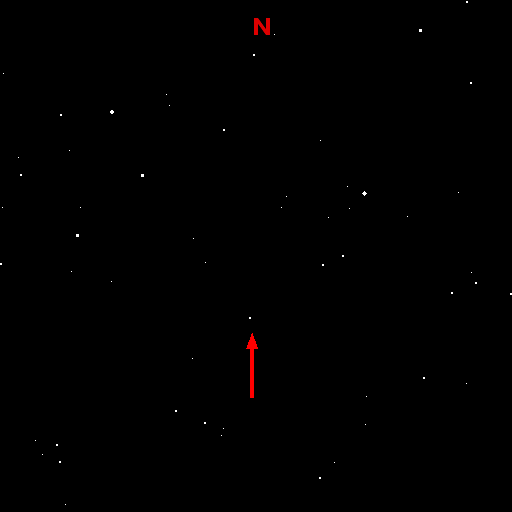
(image courtesy of "Heavens Above")

Let's look at three such star systems, moving from right to left (or west to east) on the chart above. These are Mizar and Alcor, Epsilon Lyra and Albireo.
Mizar and Alcor lie in the Big Dipper (or for our friends in the British Isles, the Plough), an asterism found within Ursa Major, the Great Bear.


(images courtesy of "Your Sky")

It used to be said that anyone who could be able to separate Mizar and Alcor with the naked eye would make good archers; in fact, this is probably just a legend, for anyone with fairly decent eyesight can do it. However, even though they appear to be near one another, they are in fact not a multiple star system at all; they are a chance alignment known as an "optical double". In order for it to be a true multiple star system, they have to be gravitationally bound to one another. Mizar, the brighter of the two, is 78 light years distant, while Alcor is 81. However, with a modest telescope, you'll find that Mizar appears to be two stars itself. Even this is deceptive, for each of those stars are in fact two stars a piece, true binary stars. The star we know as Mizar is in fact the collective light of four!
Next, we move to a rather interesting multiple star system, Epsilon Lyrae, located in Lyra, the Harp.


(images courtesy of "Your Sky")

If your eyesight is particularly good, you can see that Epsilon Lyrae is two distinct stars, Epsilon Lyrae1 and 2. To really appreciate its beauty, though, you need a telescope, for even binoculars hide the truth. For Epsilon Lyrae is a "double-double" when seen through a modest telescope; a total of four stars are visible. There is still a secret hiding here, for one of those four stars is in fact another pair of stars. Unlike Alcor and Mizar, this is in fact a true multiple star system, with the main components taking hundreds of thousands of years to revolve around their center of gravity. The entire Epsilon Lyrae star system lies around 160 light years distance.
This brings us to the most striking object of our tour of multiple stars, Beta Cygni, commonly known as Albireo, in Cygnus the Swan.


(images courtesy of "Your Sky")

Lying some 385 light years away, Albireo is perhaps one of the most beautiful objects in the summer sky if only for its contrast (incidentally, it is my personal favorite star). When viewed through a small telescope, this pale yellow star reveals itself to be two stars, one gold and the other sapphire... and they really look those colors! The differences in the two stars that make up Albireo make it one of the best objects to observe for the beginning astronomer. There are many stars out there like Albireo, but none as easy to find. As with the previous stars, there is more here than meets the eye (or telescope). The golden star, the brighter of the two, is actually a binary star, so a total of three stars make up this heavenly jewel. There is some debate as to whether or not the two main components of Albireo are even truly gravitationally bound, but if they are, their orbital period is perhaps as high as 100,000 years.
The Vagabond Astronomer will be set up in the parking lot of Books-A-Million in Mandarin the night of Saturday the 22 of July after 9 PM. I should have three scopes available, each one trained on an individual object, though I might be coaxed into turning one onto other celestial bodies. If you get a chance, do come by and visit as we look at these beautiful stars that truly have multiple personalities!

Thursday, June 22, 2006

Sheer Luna-See

It seems that whenever someone gets a new telescope or pair of binoculars, the first thing they want to do is look at the Moon. Many has been the time that I've heard some people say "why don't we wait until it's a full Moon so we can see all of it?" Sounds simple enough... it is a "full" Moon, right? However, that's really not the best time to observe the Moon at all.
Let's talk a little about our planet's one natural satellite. The Moon is pretty big when compared with Earth, a little over 1/4 its diameter (2160 miles/3476 km for the Moon, 7926 miles/12756 km for the Earth). In a very real sense, this makes the Earth/Moon system a double planet; when you compare other planets and their satellites, you find that they are much, much smaller, with Pluto being the one notable exception (and a subject for another day). Our Moon sits at around 238,000 miles/383,000 km from our humble abode, making it by far the closest of our celestial neighbors. At that distance, the Moon covers less than 1° of sky, less than your pinky finger held at arm's length. It seems bigger, but that's just a trick of the eye and mind. Ironically, the Sun also covers roughly the same area. By an incredible coincidence, both the Moon and Sun appear nearly the same size in our skies!
Geologically, the Moon appears to be dead, but it is covered with reminders of our Solar System's violent past; thousands of craters. Amazingly, though, it still gets hit from time to time. As recently as the 1st of May, 2006, astronomers using video equipment caught an impact as it occurred. There are other lunar facts that everyone should be familiar with, such as the fact that the Moon has almost no atmosphere and around 1/6 Earth gravity. It's also naturally a very dark color, almost the color of asphalt; its brilliance comes from reflected sunlight.
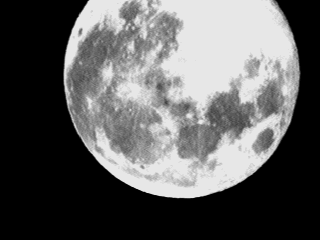
Now that we've covered the basics, let's talk about the best time to observe. As I mentioned earlier, many people are tempted to look at a full Moon. While this is fine, the video image below shows pretty much what you can expect to see.

(video image by Robert Little)

The problem with viewing the full Moon has to do with a lack of contrast. Since the Sun is pretty much straight up from the Moon, there are few shadows being cast. It's still interesting, just not very revealing. The best time to view the Moon are the phases leading up to the full Moon, and in particular the smallest ones, the crescent and quarter phases. The phase between quarter and full, gibbous, is good for some observing as well. The following low resolution video images were made on the 24th June, 2004 and show the northern and southern sections.

(video images by Robert Little)
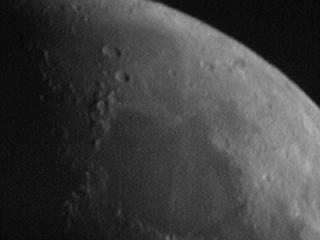
As you can see, there is a lot of detail, and the craters and various bumps and gouges really stand out. The next image was taken on the 22nd of September, 2004. This is a close-up of an almost first quarter Moon. During this phase, the large maria (literally "seas") become visible. These huge, dark plains are actually enormous basins filled with ancient lava that has hardened into a basalt. The best time to observe the maria are quarter and gibbous.

(video image by Robert Little)
In this image, which is tilted 45° to the right, the predominant features are Mare Serenitatis, the Sea of Serenity (upper center), and Mare Tranquillitatus, the Sea of Tranquility (lower center). It was in the Sea of Tranquility that the first Apollo astronauts touched down in July of 1969.
After the first quarter Moon, the phases get progressively brighter until they reach full. Then, the phases go in reverse, from gibbous to quarter and then to crescent and back to new. Of course, most of these post-full Moon phases occur pretty late and go well into the morning hours.
Whenever you plan to observe the Moon, though, it helps to have a good guide. There are plenty of good books out there about observing the Moon. Patrick Moore's classic "The Amateur Astronomer" has plenty of great information. One of the most detailed lunar observing books is "Exploring The Moon Through Binoculars" by Ernest H. Cherrington, Jr. There are some great online sources as well. Draco Productions has a simple online map. A more complex map can be found at Observatorio ARVAL's website.
The Vagabond Astronomer will be outside of Books-A-Million in Mandarin on Wednesday the 28th and Friday the 30th after 8pm both nights. Come on by as we take a long, close up look at our closest cosmic neighbor.