Monday, July 31, 2006

The Moon & The Virgin

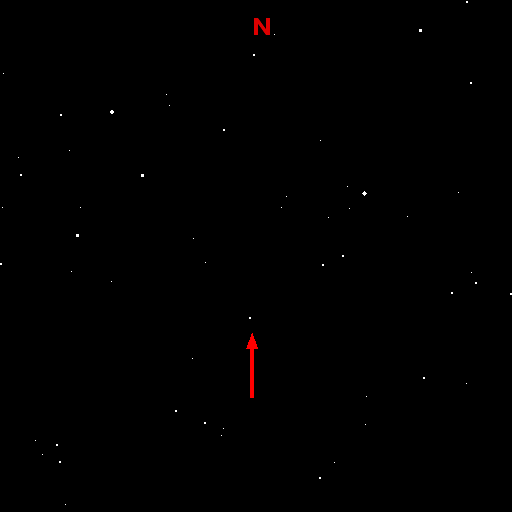
31 July 2006 - Tonight was not really a planned session for personal observing. I was at a meeting when I became distracted by the fact that, for the first time in days, the sky was clear. How could I concentrate on the meeting while the heavens were waiting? So, I left the meeting, obstensibly to try some experiments with a small digital camera (a Mercury CyberPix S-550V, pretty much just an aim-&-shoot) through my old 60mm 450mm fl short tube refractor "Bianca". But there was something else I had been wanting to see; our Moon sitting just south of the bright star Spica in the constellation Virgo. Professor Jim Kaler's website has some great information on the star, as well as many others.
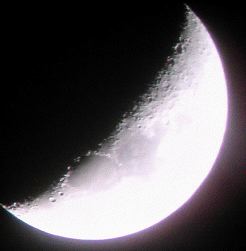
First, let's talk about my little camera experiment. Was it a success? Well... yes and no. Yes, it was successful in that it showed that the little work around I found for digital cameras worked (using a small tripod to hold the camera to the eyepiece). The images, however, were overexposed. The sensor that sets exposure does not aim into the telescope, and was pointing towards darkness. The camera's response was to increase exposure time. So, you get this...


That was the best image of the night.
Still, all was not wasted. I spent a number of minutes just looking at the Moon sitting just under Spica. It was an amazing contrast. Spica is the 16th brightest star in the night sky, and was easily holding its own against our obviously much brighter Moon (not that the Moon would actually be brighter than a star; Spica is around 260 light years away, while the Moon is 238,000 miles/383,000 km). The other stars really stood out tonight as well, the rain cleansed air being particularly clear. I spied Jupiter and the Galilean satellites. A few minutes later, I swung Bianca around and viewed Albireo.
But it was the wonderful sight of the Moon sitting in such proximity of Spica that really made the night, as our nearest celestial neighbor visited a maiden, high in the southern skies.
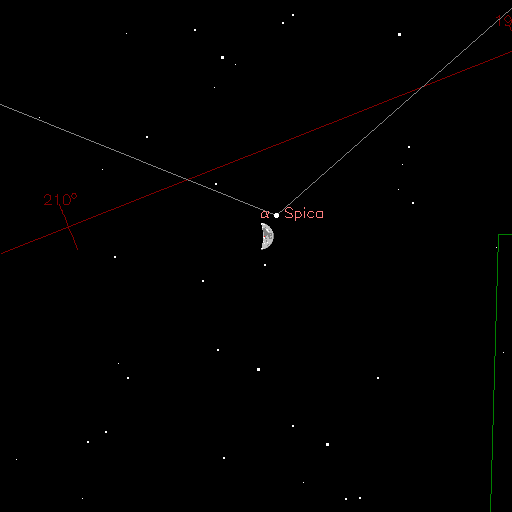
(image courtesy of "Your Sky")

Thursday, July 13, 2006

Seeing Double?

(IMPORTANT UPDATE - Read this comment)

One of the most marvelous things about the night sky is the subtle variety in the stars, and the secrets some of these stars hide. Our eyes allow us to discern color, but our eyes were not created as precision astronomical instruments. Thank goodness for optics, for what we perceive frequently as single stars may in fact be two or more. We refer to these as multiple star systems.


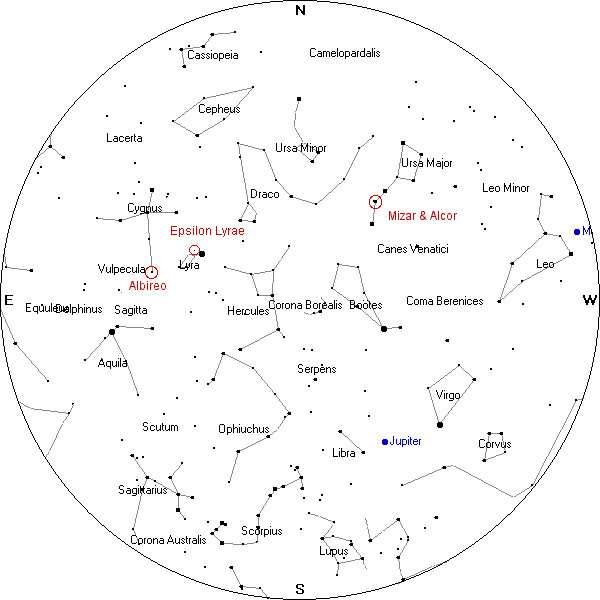
(image courtesy of "Heavens Above")

Let's look at three such star systems, moving from right to left (or west to east) on the chart above. These are Mizar and Alcor, Epsilon Lyra and Albireo.
Mizar and Alcor lie in the Big Dipper (or for our friends in the British Isles, the Plough), an asterism found within Ursa Major, the Great Bear.


(images courtesy of "Your Sky")

It used to be said that anyone who could be able to separate Mizar and Alcor with the naked eye would make good archers; in fact, this is probably just a legend, for anyone with fairly decent eyesight can do it. However, even though they appear to be near one another, they are in fact not a multiple star system at all; they are a chance alignment known as an "optical double". In order for it to be a true multiple star system, they have to be gravitationally bound to one another. Mizar, the brighter of the two, is 78 light years distant, while Alcor is 81. However, with a modest telescope, you'll find that Mizar appears to be two stars itself. Even this is deceptive, for each of those stars are in fact two stars a piece, true binary stars. The star we know as Mizar is in fact the collective light of four!
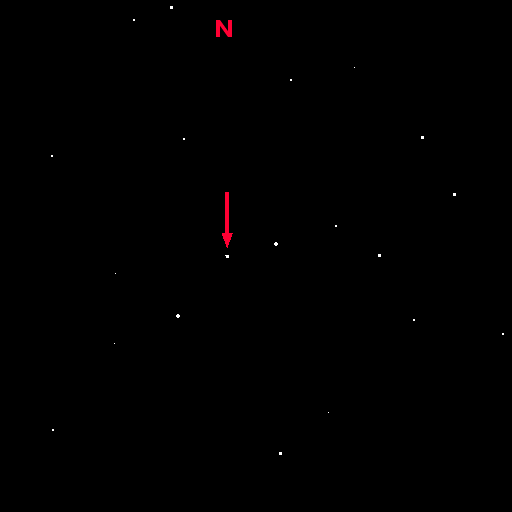
Next, we move to a rather interesting multiple star system, Epsilon Lyrae, located in Lyra, the Harp.


(images courtesy of "Your Sky")

If your eyesight is particularly good, you can see that Epsilon Lyrae is two distinct stars, Epsilon Lyrae1 and 2. To really appreciate its beauty, though, you need a telescope, for even binoculars hide the truth. For Epsilon Lyrae is a "double-double" when seen through a modest telescope; a total of four stars are visible. There is still a secret hiding here, for one of those four stars is in fact another pair of stars. Unlike Alcor and Mizar, this is in fact a true multiple star system, with the main components taking hundreds of thousands of years to revolve around their center of gravity. The entire Epsilon Lyrae star system lies around 160 light years distance.
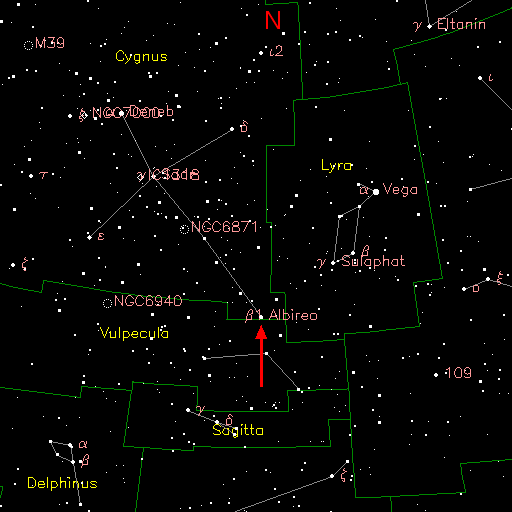
This brings us to the most striking object of our tour of multiple stars, Beta Cygni, commonly known as Albireo, in Cygnus the Swan.


(images courtesy of "Your Sky")

Lying some 385 light years away, Albireo is perhaps one of the most beautiful objects in the summer sky if only for its contrast (incidentally, it is my personal favorite star). When viewed through a small telescope, this pale yellow star reveals itself to be two stars, one gold and the other sapphire... and they really look those colors! The differences in the two stars that make up Albireo make it one of the best objects to observe for the beginning astronomer. There are many stars out there like Albireo, but none as easy to find. As with the previous stars, there is more here than meets the eye (or telescope). The golden star, the brighter of the two, is actually a binary star, so a total of three stars make up this heavenly jewel. There is some debate as to whether or not the two main components of Albireo are even truly gravitationally bound, but if they are, their orbital period is perhaps as high as 100,000 years.
The Vagabond Astronomer will be set up in the parking lot of Books-A-Million in Mandarin the night of Saturday the 22 of July after 9 PM. I should have three scopes available, each one trained on an individual object, though I might be coaxed into turning one onto other celestial bodies. If you get a chance, do come by and visit as we look at these beautiful stars that truly have multiple personalities!

Thursday, June 22, 2006

Sheer Luna-See

It seems that whenever someone gets a new telescope or pair of binoculars, the first thing they want to do is look at the Moon. Many has been the time that I've heard some people say "why don't we wait until it's a full Moon so we can see all of it?" Sounds simple enough... it is a "full" Moon, right? However, that's really not the best time to observe the Moon at all.
Let's talk a little about our planet's one natural satellite. The Moon is pretty big when compared with Earth, a little over 1/4 its diameter (2160 miles/3476 km for the Moon, 7926 miles/12756 km for the Earth). In a very real sense, this makes the Earth/Moon system a double planet; when you compare other planets and their satellites, you find that they are much, much smaller, with Pluto being the one notable exception (and a subject for another day). Our Moon sits at around 238,000 miles/383,000 km from our humble abode, making it by far the closest of our celestial neighbors. At that distance, the Moon covers less than 1° of sky, less than your pinky finger held at arm's length. It seems bigger, but that's just a trick of the eye and mind. Ironically, the Sun also covers roughly the same area. By an incredible coincidence, both the Moon and Sun appear nearly the same size in our skies!
Geologically, the Moon appears to be dead, but it is covered with reminders of our Solar System's violent past; thousands of craters. Amazingly, though, it still gets hit from time to time. As recently as the 1st of May, 2006, astronomers using video equipment caught an impact as it occurred. There are other lunar facts that everyone should be familiar with, such as the fact that the Moon has almost no atmosphere and around 1/6 Earth gravity. It's also naturally a very dark color, almost the color of asphalt; its brilliance comes from reflected sunlight.
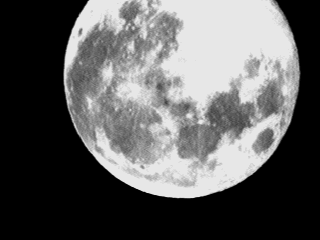
Now that we've covered the basics, let's talk about the best time to observe. As I mentioned earlier, many people are tempted to look at a full Moon. While this is fine, the video image below shows pretty much what you can expect to see.

(video image by Robert Little)

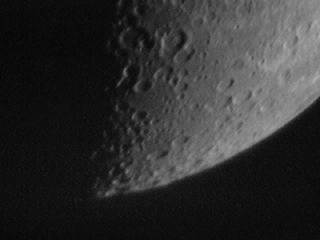
The problem with viewing the full Moon has to do with a lack of contrast. Since the Sun is pretty much straight up from the Moon, there are few shadows being cast. It's still interesting, just not very revealing. The best time to view the Moon are the phases leading up to the full Moon, and in particular the smallest ones, the crescent and quarter phases. The phase between quarter and full, gibbous, is good for some observing as well. The following low resolution video images were made on the 24th June, 2004 and show the northern and southern sections.

(video images by Robert Little)
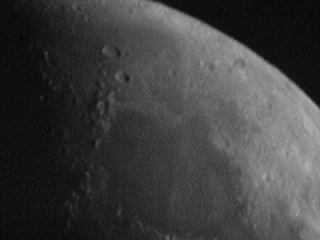
As you can see, there is a lot of detail, and the craters and various bumps and gouges really stand out. The next image was taken on the 22nd of September, 2004. This is a close-up of an almost first quarter Moon. During this phase, the large maria (literally "seas") become visible. These huge, dark plains are actually enormous basins filled with ancient lava that has hardened into a basalt. The best time to observe the maria are quarter and gibbous.

(video image by Robert Little)
In this image, which is tilted 45° to the right, the predominant features are Mare Serenitatis, the Sea of Serenity (upper center), and Mare Tranquillitatus, the Sea of Tranquility (lower center). It was in the Sea of Tranquility that the first Apollo astronauts touched down in July of 1969.
After the first quarter Moon, the phases get progressively brighter until they reach full. Then, the phases go in reverse, from gibbous to quarter and then to crescent and back to new. Of course, most of these post-full Moon phases occur pretty late and go well into the morning hours.
Whenever you plan to observe the Moon, though, it helps to have a good guide. There are plenty of good books out there about observing the Moon. Patrick Moore's classic "The Amateur Astronomer" has plenty of great information. One of the most detailed lunar observing books is "Exploring The Moon Through Binoculars" by Ernest H. Cherrington, Jr. There are some great online sources as well. Draco Productions has a simple online map. A more complex map can be found at Observatorio ARVAL's website.
The Vagabond Astronomer will be outside of Books-A-Million in Mandarin on Wednesday the 28th and Friday the 30th after 8pm both nights. Come on by as we take a long, close up look at our closest cosmic neighbor.

Saturday, June 17, 2006

A Dearth Of Stars

There are certain times of the year when it seems that the sky is just uninteresting. There's a lack of bright stars, easy to find deep sky objects and the constellations themselves just seem faint. Here in the northern hemisphere, this is spring and autumn, obviously reversed for the southern hemisphere.
Yet if we live in a galaxy that has between 100 and 400 billion stars, then why such a dearth? Well, it has to do with the fact that our Solar System is tilted.
The picture below shows the entire night sky, all 360° of it. You'll notice that most of the brighter stars seem to follow a serpentine pattern. That is the actual galactic plane, what we know as the Milky Way itself.

(image produced with Star Atlas v.06b1 by Youhei Morita)

Our Milky Way galaxy is a barred spiral, essentially a flat, spinning disk with a slight bulge near the center and over 100,000 light years across. Our little Solar System is located some 30,000 light years from the center, as indicated by the circle near the top center of the Milky Way map (which, I admit, is based on the best information we have available and is probably still far from accurate. Incidentally, our Solar System would be near the center of the circle, microscopic in this scale. Very microscopic...).


(image by Robert Little)

If our Solar System was aligned so that our Sun's axis lined up with the galactic axis, we'd never want for Milky Way filled nights, and only the view towards our poles would show fewer stars than around the ecliptic (the main plane of the Solar System, the imaginary belt in which most of the planets lie). Instead, our Solar System is actually tilted 62° from the galactic plane itself, almost lying on its side.
(image by Robert Little)

As a result, there are times when our night sky actually faces out through our galactic plane, through less densely populated sections of our local interstellar neighborhood. This is why the stars in the spring and autumn seem to be lacking. That's not to say that it isn't worth still doing; stargazing should be enjoyed all year round. Still, if your wondering why the night sky is so humdrum, just remember we're tilted. It's all in how we're aligned.

Monday, June 12, 2006

Planets In The Western Skies

Friday the 16th of June looks to be promising from a planetary view point... at least the view from the planet Earth. And the excitement begins just after sunset.

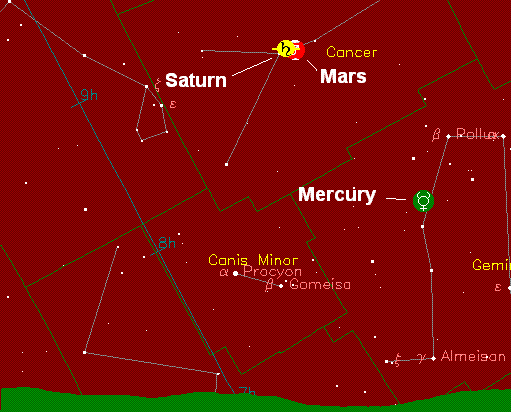
(image courtesy of "Your Sky" )

In total, three planets should be visible in the western sky just after sundown; from the horizon up, Mercury, Mars and Saturn. Let's start with the least visible of the bunch, Mercury.
As you probably well know, doing astronomy just after the Sun has disappeared below the horizon is tough, especially if you intend to look in that general direction. At 8:30pm EDT, Mercury will be just about 10° above the horizon and visible in the twilight glow. As far as planets go, little Mercury is the runt of the inner Solar System, the first of the so-called "Terrestrial Planets" (as opposed to the outer Solar System, which is dominated by the "Gas Giants"). It isn't big at all, a little over 3000 miles (4880 km) in diameter, about 1 1/2 times the size of our own Moon. Because of that, don't expect much even with a big telescope; Mercury is a small planet to begin with, and we're seeing it from over 100 million miles (160 million kilometers) away. The problem locally will be one of haze. We're entering into the hot months now, and northeast Florida does get notoriously hazy this time of year. However, we're also expecting storms on Friday, and they can help to clear a lot of that up. Either way, little starlike Mercury is only the beginning of the happenings on the 16th. A better show is just a little higher up.
From time to time, the planets appear to close in on one another in our skies. Of course, they are actually very, very far apart, but this does make for some great observing possibilities. That's what we'll have in Saturn and Mars.

(image courtesy of "Solar System Live" )

They're going to look close. Real close. The apparent angle of separation (that's geek-speak for how far they appear apart) will be around 1°, or almost two full Moons. Due to the enormous differences in their sizes, though, they will look very different from one another. Mars is a little more than half the size of Earth, 4221 miles (6794 km) and glows with an orange-tan glow. Saturn, on the other hand, is over 17 times as big, almost 75000 miles (120700 km) in diameter. Even though Saturn will almost be a billion miles out (1.6 billion km), it will still outshine Mars!
The Vagabond Astronomer will be setting up at County Dock in Mandarin around 8:00 pm. This gives us the best view west. Because of how crowded the conditions are out there, only one scope will be used, and no, I will not be setting up on the dock itself but next to it. Besides, brackish water and fine optics do not a good couple make.
Hope to see you there.

Wednesday, June 07, 2006

Practicing Random Acts Of Astronomy

Why be random?
The late spring months here in the northern hemisphere seem ideal for astronomy, at least for the climate. True, the deep sky really isn't that interesting until summer rolls on in. Fortunately, right now we're blessed with Saturn still visible in the west, Jupiter brilliantly glowing in the east, and for the last two nights, a nice first quarter and waxing gibbous Moon. The nice thing about these objects is that light pollution doesn't really make an impact on them.
Which brings me back to the whole random issue.
At all times, yours truly keeps two telescopes on alert standby; my little 55mm copyscope refractor "Lil' Bernie" and my 152mm (6") Schmitt-Cassegrain "Dyna". Most of the time, they simply live in my car (which, I'll have you know, is a 1986 model Chevrolet Celebrity that sounds and feels like it's trying to break the sound barrier when passing 55 MPH). The nice thing about this arrangement is that it allows me to just setup a telescope anywhere, at any time. There's also a box of eyepieces, and occasionally Lil' Bernie's solar filter.
This means that sometimes I'll post a session here in the VA Blog after the fact. Like now. In fact, not just one session, but two. Done on the spur of a moment. Randomly. Spontaneously (note the use of single words for emphasis. And fragments. Great literary device. Must use this again. Later).
Last night, 6th June, 2006, I setup in the field at Mandarin Park before sunset. Seems a little odd, but the Moon looked perfect against a sapphire backdrop. This was a great opportunity to introduce park visitors to our nearest celestial neighbor, and indeed a few people did partake of this little slice of the sky. It is amazing what can be seen on the Moon even with the Sun still high in the west. That session ended before 9 PM, and was pretty straightforward.
Tonight, though, I did something I've been wanting to do for years. I sat up Dyna and Lil' Bernie on the sidewalk outside of Fort Castillo de San Marco in beautiful St. Augustine, near the water's edge. This was a great location to take in not only the Moon, but because it was later, we were able to catch Jupiter as well. Sadly, Saturn was simply too dim, occluded by thick cirrus clouds, looking like dark mare's tails against a darkening sky.
The biggest problem was one of parking. I had to park over a quarter of a mile (500 meters, give or take) from where I wanted to setup and lug the equipment. I'm not as young as I used to be, but miraculously, I survived.
Most of the people who came up (all in all, I reckon 30 in total) were tourists, save for one mature couple who just moved to St. Augustine from Ft. Lauderdale. In fact, they sat on the sea wall nearby and pretty much kept me company most of my session. The children tonight really made it all worthwhile. They'd look at the Moon and Jupiter, mouths agape with "whoa"'s and "wow"'s.
By 9:30 PM, I decided to call it a night. I was tired and dreaded carrying almost 100 pounds (for you metric folks... around 50 kg) back to my car. The trip home, my car vibrating and rattling as I tore through the night down Interstate 95, sounding at times like it was trying to survive atmospheric entry, I reflected on it all; the
gibbous Moon hanging there over Anastasia Island, the thin, wispy clouds still catching the vanishing rays of the Sun, Jupiter shining like a mad diamond, the smell of saltwater and the feel of a stiff ocean breeze. And the people who came up and wanted to catch their own little piece of the sky.
That's what practicing random acts of astronomy is all about.

Wednesday, May 17, 2006

The Night Of The Gas Giants

They may be giants...
Actually, they are, four of them in fact. These are the Gas Giants, the four largest bodies in our Solar System. This month, and through most of June, our night skies will be blessed with not one, but two of them, Jupiter and Saturn. To be honest, these two are the easiest to see from Earth, if only due to their size (however, they're also much closer than the outer two); Jupiter is around 11 times the size of our humble planet, while Saturn is roughly 9 times our diameter. In short, these are big worlds.
Both planets have numerous, notable features. Jupiter, the larger (and brighter) of the two is noted for the Great Red Spot, a huge storm that revolves around the planet just south of Jupiter's equator. The Great Red Spot is so large that you can drop the Earth through it and not even touch its edges. This storm has raged for centuries, and may continue to do so for many more.
Another, easily noticeable feature of Jupiter are its four largest moons. Ganymede, Io, Europa and Callisto; these are the so called "Galilean Satellites", named for their discoverer, Galileo Galilei. These were in fact the first moons found to orbit another world, and were first seen in January of 1610. And they are big. Ganymede is the largest satellite in our Solar System, easily larger than the planet Mercury. In total, Jupiter has over 60 moons; another notable feature indeed!
Not to be outdone, Saturn is also very lovely to look at due to its huge ring system. To be fair, all four Gas Giants have rings, but Saturn's are the only ones truly visible from Earth (unless, of course, you have a 6 meter telescope and really good imaging equipment). These rings are possibly the remains of a moon that broke up, no doubt due to Saturn's gravitational force. On the subject of moons, Saturn has over 40, the largest of which, Titan, is truly unique. It has an atmosphere that is composed primarily of nitrogen but which also has a methane "smog" that blankets the moon. There is a very real possibility that hydrocarbons actually rain down onto its surface. It is in many ways Earth-like, except many times colder. So cold, in fact, that frozen water behaves much as rock does here on Earth, even breaking up into frozen water "sand".
To find these worlds this month and through June, one doesn't have to look too hard. Jupiter simply can't be missed, rising high into the eastern skies after sunset, and by far the brightest "star" in the sky. Saturn is a bit dimmer and lies more to the west. By mid-June, Saturn will begin disappearing into the western twilight.


Not too long ago, Saturn appeared much brighter. Amazingly, it's still bright, but when you realize that Saturn is right now over 877 million miles (1.416 billion kilometers) away, its size and majesty truly hit home. Jupiter is only 409 million miles (660 million kilometers) away, less than half the distance, but of course its also 20% larger than Saturn. Below is a chart showing their relative position (though obviously not to scale) for the night of 19 May 2006, courtesy of Fourmilab's Solar System Live.


For this session of the Vagabond Astronomer, I'll be set up in the parking lot of Books-A-Million on Friday, 19th May 2006 after 8:30pm (See Platial link on the right). Hopefully you can come out and visit as we take in these two majestic wonders and really enjoy the Night of the Gas Giants. Looking forward to seeing you there!

Monday, May 15, 2006

The Adventure Begins

(Composed while listening to Bela Fleck's "Turtle Rock"... just to set the mood...)
Why am I doing this? "Oh no, not another blog from Robert," I'm sure will cross some minds. But trust me here, there's a reason that this one has to be posted, aside from my usual tendency of needing a creative outlet for all of my (usually misspent) energy.
I want to share the sky. That's what this blog is all about.
Does that mean that there will be star charts and do-it-yourself tips and the like here? Probably. But more than anything else, I want this space to be where I share my experiences as an amateur astronomer and a wee, little human lost in this great, big cosmos.
I'll also be travelling a lot. Let me explain.
I plan on linking this page to my Platial spot. Platial allows you to make maps... all sorts of maps, of whatever you fancy. My goal is to occasionally set up my telescopes somewhere in Northeast Florida and share the heavens with any soul who wonders by, the very essence of sidewalk astronomy.
Why do it this way? Won't there be a problem with light pollution? What can you see from an urban setting? The answers to those questions are because I can, of course there will be and a lot more than you realize.
Come along and join me on this adventure! I'll even post my plans in advance, sound like a deal?
Good.
Let's go.